To be the leading interdisciplinary hub for cognitive science research, driving innovation in cognitive technologies and improving human performance, well-being, and decision-making, and its translation into groundbreaking applications that empower individuals and organizations to thrive in an increasingly complex world.
Cognitive Science
Understanding perception, memory, reasoning, and the computational nature of thought.
To integrate insights from diverse disciplines, including psychology, computer science, philosophy, and linguistics, to deepen our understanding of the complex processes underlying human perception, emotion, learning, reasoning, and decision-making, and apply these insights to enhance human cognition and performance.
The questions and outcomes this division concentrates on, drawn directly from its vision and mission.
Interdisciplinary integration
Bringing together insights from psychology, computer science, philosophy, and linguistics.
Processes of the mind
Understanding perception, emotion, learning, reasoning, and decision-making.
Cognitive technologies
Driving innovation in cognitive technologies and groundbreaking applications.
Human performance
Improving human performance, well-being, and decision-making.
Themes our contributors explore, summarized from the division's published articles.
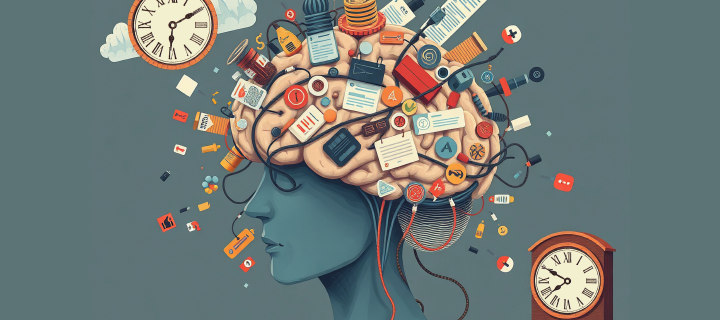
Cognitive load and decision quality
When mental demands exceed working memory, decisions degrade: people lean on biases, act impulsively, default to the status quo, and self-control weakens as fatigue builds.
Language and thought
Linguistic relativity holds that a language's grammar, vocabulary, and metaphors shape perception, emotion, and reasoning, influencing how we handle colour, space, time, and culture.
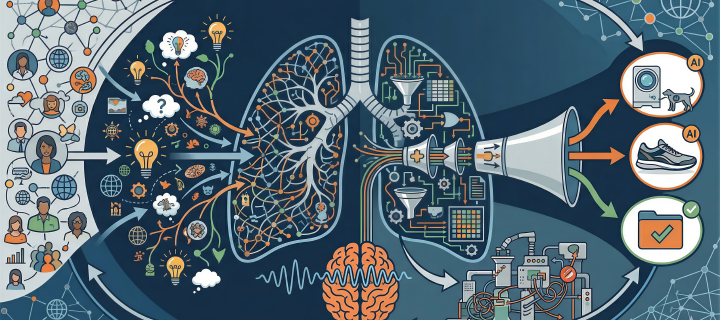
Divergent and convergent creativity
Innovation cycles between divergent idea generation and convergent refinement, driven by the interplay of the brain's default mode and executive control networks plus supportive environments.
AI and human cognition
AI matches or beats humans at narrow tasks but lacks consciousness, genuine empathy, and moral reasoning, so it simulates understanding rather than truly grasping human experience.
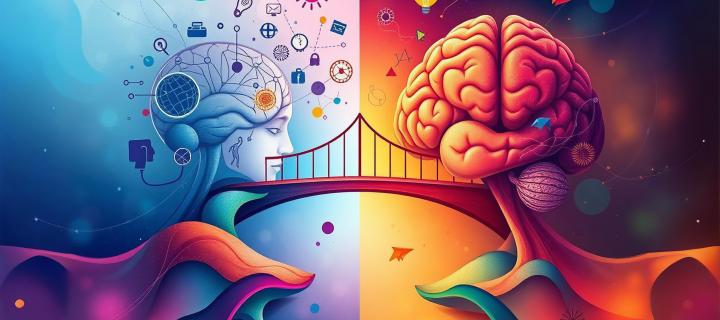
Bridging psychology and neuroscience
Cognitive science links mental function to neural mechanism using neuroimaging, computational models, and lesion studies, connecting processes like memory and decision-making to brain activity.
Further reading
The Impact of Cognitive Load on Decision-Making Efficiency
The expert-novice paradigm, well-documented in cognitive psychology, highlights fundamental differences in decision-making processes.
Cognitive Science: Bridging the Gap Between Psychology and Neuroscience
For centuries, the nature of human consciousness and cognition has been the ultimate scientific frontier.
The Depleted Mind: The Science of Decision Fatigue and Ego Depletion
The contemporary human experience is defined by an unprecedented volume of choice. From the moment of waking, the modern individual is confronted with a…
The Innovation Breath: Architecting the Neural Cycle of Divergent and Convergent Thinking
For decades, innovation has been misunderstood as a linear sequence, a spark of genius followed by methodical execution and eventual market introduction.